


I love Bunnings. Like genuinely love it. I drive twenty minutes once a week just to walk the aisles and grab a hot snag. I even remodelled my entire kitchen with them. I also used them to paint my whole house.
My brother is a tradie and drives over an hour twice a week because he loves the store that much.
Bunnings is a cultural institution in Australia. There is no other way to put it. The sausage sizzle on a Saturday morning, the green and red warehouse that every Aussie recognises from five hundred metres away, the weekend project runs that somehow always end with three extra bags of things you never planned to buy.
It is part of the fabric of this country.
But for a company doing nineteen point six billion dollars in revenue, they are leaving hundreds of millions of dollars sitting on the table. And the fixes are not complicated. They are standard practices that most mid-size online retailers already have in place.
I am not here to tear Bunnings down. I am here to show where the money is hiding.
The Follow-Up That Never Comes
After you buy something from Bunnings, they follow up twice asking for a review. That part works fine. But here is what they do not do. They do not follow up with related products you actually need.
I bought a lawn mower from Bunnings. After the purchase I got the review request and that was the end of the relationship. No email about lawn seed. No suggestion for fertiliser. No sprinkler systems. No seasonal lawn care tips. Nothing.
They have the data. They know what I bought. They know the category. They know the season. They have everything they need to send me a simple automated sequence that says hey, you just bought a mower, here is what you need to keep that lawn looking sharp. But they are not using any of it.
This is not cutting-edge marketing. This is basic post-purchase automation that any Shopify store with a free Klaviyo account can set up in an afternoon. For a company turning over nearly twenty billion dollars, the absence of this is staggering.
Site Speed Is Killing Conversions
Most people do not even use the Bunnings website properly. They go to Google and type the product name plus the word Bunnings. Why? Because the internal search on the site is terrible. Slow, clunky, frustrating. Even staff in-store struggle to find things using their own system.
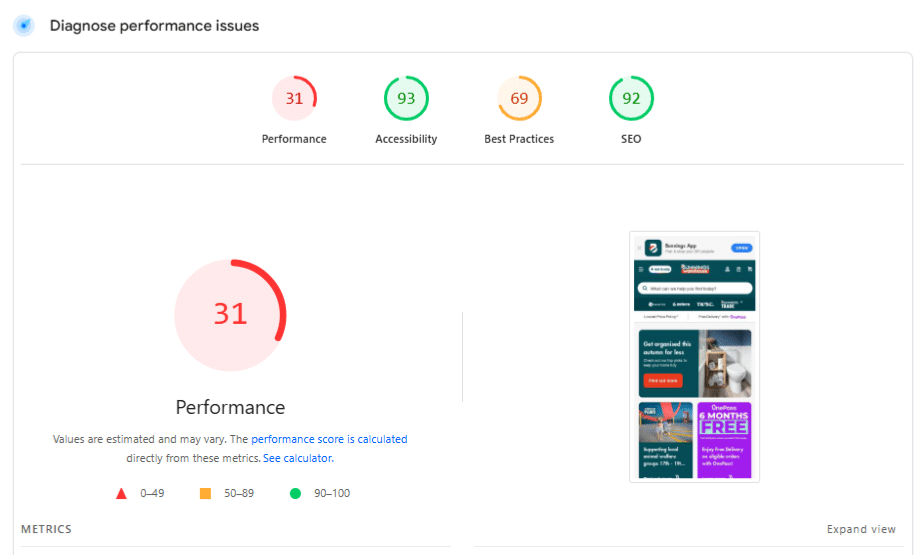
So customers are literally leaving the Bunnings website just to navigate it. They go out to Google, run a search, and come back in through a search result. That is an extra step that should not exist. Every extra step is a chance for someone to land on a competitor page instead.

Their site speed score sits at twenty-nine out of one hundred. To put that in context, anything under fifty is considered poor by Google. A one-second delay in page load time reduces conversions by seven percent. Amazon found that every one hundred milliseconds of latency cost them one percent in sales.
When you are doing the kind of revenue Bunnings is doing, those percentages translate into enormous dollar figures.
The technical fix for site speed is not a six-month rebuild. It is roughly two days of focused work. Compress images. Lazy load content below the fold. Minimise render-blocking scripts. Set up proper browser caching.
This is industry-standard optimisation that any competent developer can knock out in a weekend sprint. The fact that it has not been done on a site generating this much traffic is hard to explain.
The Checkout Problem
This is the big one and it is worth understanding because it applies to almost every business, not just Bunnings.
Someone visits the site. They find what they want. They add it to the cart. They get to checkout. And the first thing Bunnings asks them is about store location. Delivery or click and collect. Logistics.
That might seem logical from an operations perspective, but from a marketing and revenue perspective it is completely backwards. At that point in the checkout process, Bunnings has not captured the customer’s email address, name, or phone number.
So when that person abandons the cart, and the industry average says around seventy percent of online shoppers do, Bunnings has no way to follow up. No abandoned cart email. No SMS reminder. No retargeting sequence. Nothing. The customer is gone and there is no way to bring them back.
The fix is simple. Capture the contact information first. Get the email. Get the name. Then move into logistics and fulfilment options. That way, even if the customer drops off at any point after that first step, you have what you need to start a recovery sequence.
Shopify data shows that abandoned cart emails recover around twenty-three percent of lost sales. Let that sink in. If ten percent of Bunnings revenue comes through online channels, that is roughly one point nine billion dollars in online sales.
Losing seventy percent of carts at checkout means there is a massive pool of potential revenue sitting in abandoned sessions. Improving capture by just five percent represents a ninety-five million dollar swing. And recovering even a fraction of abandoned carts through email follow-up could be worth tens of millions more on top of that.
A Two Percent Shift Is Worth Nearly Four Hundred Million
Bunnings reported earnings of two point three three six billion in their most recent financial year. Growth came in at three point eight percent. That is modest for a company of this size and signals a mature, high-volume, low-growth phase.
The big gains are not coming from new foot traffic. They are coming from doing more with the traffic and customers they already have.
A two percent increase in conversion rate on nineteen point six billion in revenue is worth an extra three hundred and ninety-one point nine million dollars. Not from new customers. Not from new stores. Just from converting a slightly higher percentage of the people already walking through the door or landing on the website. That is the power of optimising what you already have.
Content Without Capture
I looked around the Bunnings website for educational content and found a great guide on smoking meat and fish. Genuinely good content. Well written, useful, the kind of thing a weekend warrior would bookmark and come back to.
But they did not ask for my email. There was no opt-in form on the page. No incentive to subscribe. No downloadable version. And there was no clear list of related items I could buy right there and then. No smoker chips. No meat thermometers. No rub kits. No accessories. Nothing ready to add to the cart while I was engaged and interested in the topic.
They gave me the guide and let me walk away. That is content marketing without the marketing. The whole point of producing that kind of content is to capture the reader as a lead, build a relationship through email, and bring them back to buy.
Bunnings did the hard part, creating the content, then skipped the part that actually makes it pay off.
Every guide on that site should have an email capture form on it.
Offer a downloadable checklist or a seasonal tips series in exchange for the email. Build the database. Then automate the follow-up.
Someone reads a guide on smoking? Send them a three-part email series on setting up a backyard smoker station, with product links baked into every email. That is how you turn content into revenue.
The same principle applies to their how-to videos, project planners, and category pages. Every piece of content that attracts an engaged visitor is a chance to start a relationship. Without the capture mechanism, that visitor consumes the content, gets the value, and leaves with no reason to come back.
The content did its job of attracting attention, but nobody built the bridge between attention and transaction.
Customer Service Reputation
Bunnings has a two point one out of five rating on Trustpilot. On Product Review, it sits at one point five. Eighty-seven percent of customer experiences recorded on those platforms are negative. The complaints follow a pattern. Terrible delivery experiences. Poor in-store service. Products arriving damaged or late.
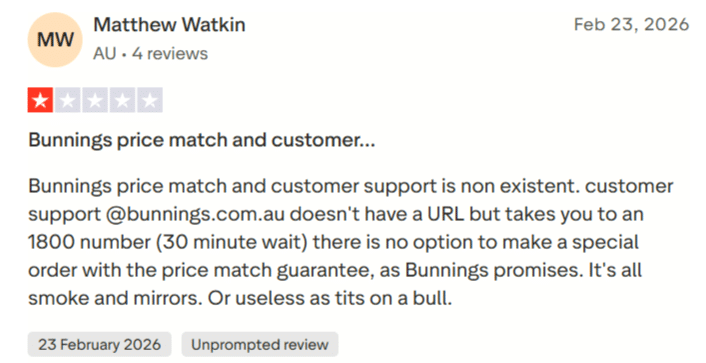
Now, Bunnings is a massive operation and some level of complaints is expected at that scale. But the issue is not just the complaints themselves. It is the lack of a visible recovery system.
When a customer has a bad experience and goes public with it, that review lives on the internet forever. It influences every future customer who searches for “Bunnings reviews” before making a large purchase.
The fix does not require a complete overhaul. A ten dollar voucher and a genuine apology costs the business almost nothing. But it can turn a one-star reviewer into someone who updates their review, comes back, and spends another few hundred dollars over the next twelve months.
The lifetime value of a retained customer far outweighs the cost of a small gesture. Most businesses underestimate how much damage an unresolved complaint does and how cheaply it can be fixed.
What Smart Operators Do Differently
Smart operators in retail and ecommerce follow a simple playbook. They capture the lead as early as possible. They upsell complementary products at the point of sale. They cross-sell related bundles in the post-purchase window.
They follow up with automated email and SMS sequences. And they bring people back without lifting a finger because the system runs itself.
Someone abandons a cart? The sequence fires. Someone views a product page three times without buying? A reminder goes out. Someone buys a barbecue? They get an email about covers, cleaning kits, and premium charcoal within forty-eight hours.
None of this requires a human being to press a button. It runs on automation that is set up once and generates revenue indefinitely.
Bunnings is doing the opposite. They are resetting their revenue to zero every single day. New visitors come in, buy once, leave, and are gone. There is no system pulling them back. No automated follow-up. No lifecycle marketing.
Every day starts from scratch, and for a company of this size, that is an extraordinary amount of money being left behind.
The Opportunity
Bunnings does not have a traffic problem. Millions of Australians visit their stores and website every week. They do not have a product problem either. The range is massive and covers almost every category a homeowner or tradie could need.
And they do not have a brand problem. Bunnings is one of the most trusted and loved brands in the country.
What they have is a systems problem. The backend infrastructure for capturing, nurturing, and converting customers is either missing or broken. High volume with low conversion optimisation means enormous amounts of potential revenue are slipping through the cracks every single day.
Fix site speed. Capture emails first at checkout. Automate the post-purchase follow-up. Build sequences around content engagement. Recover abandoned carts. Respond to negative reviews with small gestures that protect lifetime value.
None of this is revolutionary. It is the basic operating system that every serious online retailer runs on. And when you apply it to a business doing nearly twenty billion dollars in revenue, the upside is not marginal. It is hundreds of millions of dollars waiting to be picked up.
One of Australia’s most loved brands is flying blind on the backend.
They have the traffic, the trust, and the products. What they do not have is the system to turn browsers into buyers and buyers into repeat customers. And until they build it, that fortune is just going to keep sitting there. Waiting.