

Anytime Fitness is one of the biggest gym franchises in the world. Thousands of locations. A recognisable brand that most Australians could name without thinking. A genuine app with real features.
They have built something significant, and that deserves respect before anything else gets said.
But when I sat down and went through their website as a potential customer, what I found was a digital experience that is actively working against them. Not in dramatic, headline-grabbing ways.
In quiet, structural ways that bleed memberships and revenue every single day without anyone noticing.
I am not here to tear Anytime Fitness down. I am here to show where the money is hiding.
And there are small signals that suggest no one is paying close attention to the digital side.
The copyright notice in the footer is out of date. That is a tiny detail on its own, but it tells you something. If the basics are not being maintained, it raises questions about what else is being overlooked. First impressions matter, and every element on a website either builds trust or chips away at it.
The Pricing Problem
I went to the Anytime Fitness website and looked up the Melbourne CBD location. I wanted to know one simple thing. How much does a membership cost?
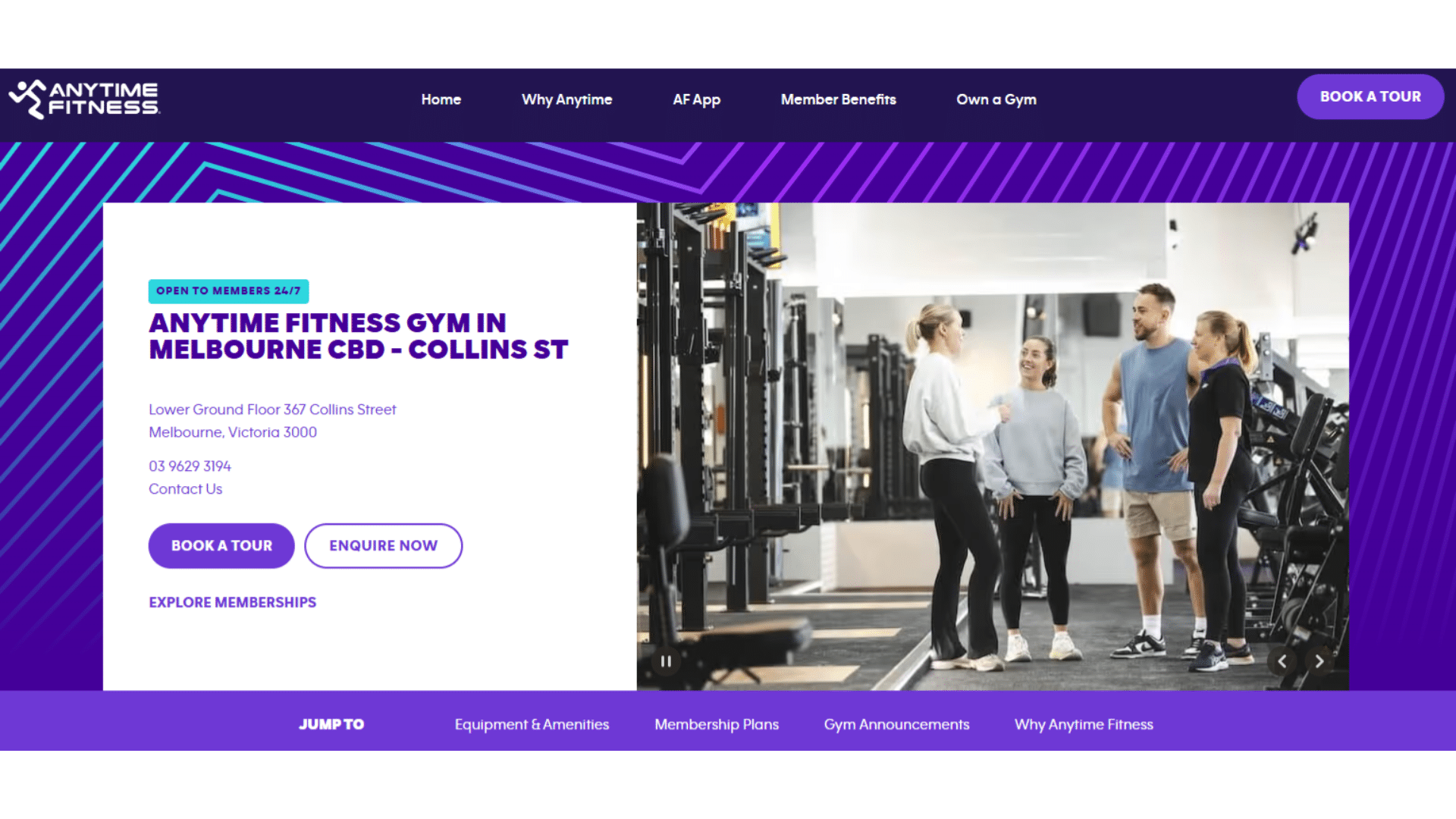
I clicked around. Nothing. I scrolled down. Still nothing. I hit the button that said explore memberships, expecting to finally see a price. Instead I got pushed into a lead capture form. Name. Email. Phone number.

All before I had any idea what the membership actually costs.
That is friction. And friction kills buyers.
People do not want to fill out a form and wait for a phone call just to find out whether something fits their budget. They want the information upfront so they can make a decision on their own terms. When you hide pricing, you are not creating exclusivity or intrigue.
You are creating frustration. And frustrated visitors do the same thing every time. They leave and go to a competitor who makes it easier.
Now, I understand the challenge. Each Anytime Fitness location is independently owned. Prices vary by location. That is a legitimate operational reality. But it is not an excuse to hide pricing entirely.
When someone clicks on the Melbourne CBD gym, or the Shepparton gym, or whatever location is closest to them, they should see exactly what memberships are available and what they cost at that specific location. Let people self-qualify. Let them look at the price and decide for themselves whether it works. Remove the barrier. Make it easy to say yes.
The current setup does the opposite. It creates a gate where there should be an open door. And every person who hits that form and decides it is not worth the hassle is a lost membership that never gets counted because the business never even knew they were there.
Think about it from the customer’s perspective. They are sitting on the couch after work, phone in hand, comparing three or four gyms in their area. One gym shows the price clearly. Another has a free trial button with no form.
And Anytime Fitness wants them to hand over their name, email, and phone number just to find out what it costs. Which gym do you think gets the signup? The one that made it easy. Every time.
There is also a secondary cost to hiding pricing that most businesses do not consider. When you force people into a form to get basic information, you fill your sales pipeline with low-intent leads who were just curious.
Your sales team spends time following up with people who were never going to buy at that price point. That is wasted labour, wasted energy, and wasted opportunity cost that could have been spent on high-intent prospects who already saw the price and still wanted to talk.
Selling Features Instead of Outcomes
Anytime Fitness has a solid app. It genuinely works. Progress tracking, customised workout plans, scheduling, all the tools a member needs to stay on track. That is a real asset. But the way they talk about it on the website is breaking the number one rule of marketing.
They are selling what they do instead of what the customer gets.
Look at the messaging on the site. Designed with your goals in mind. Monitor your progress in one place. Customised to meet you where you are at. That all sounds fine in a boardroom presentation.
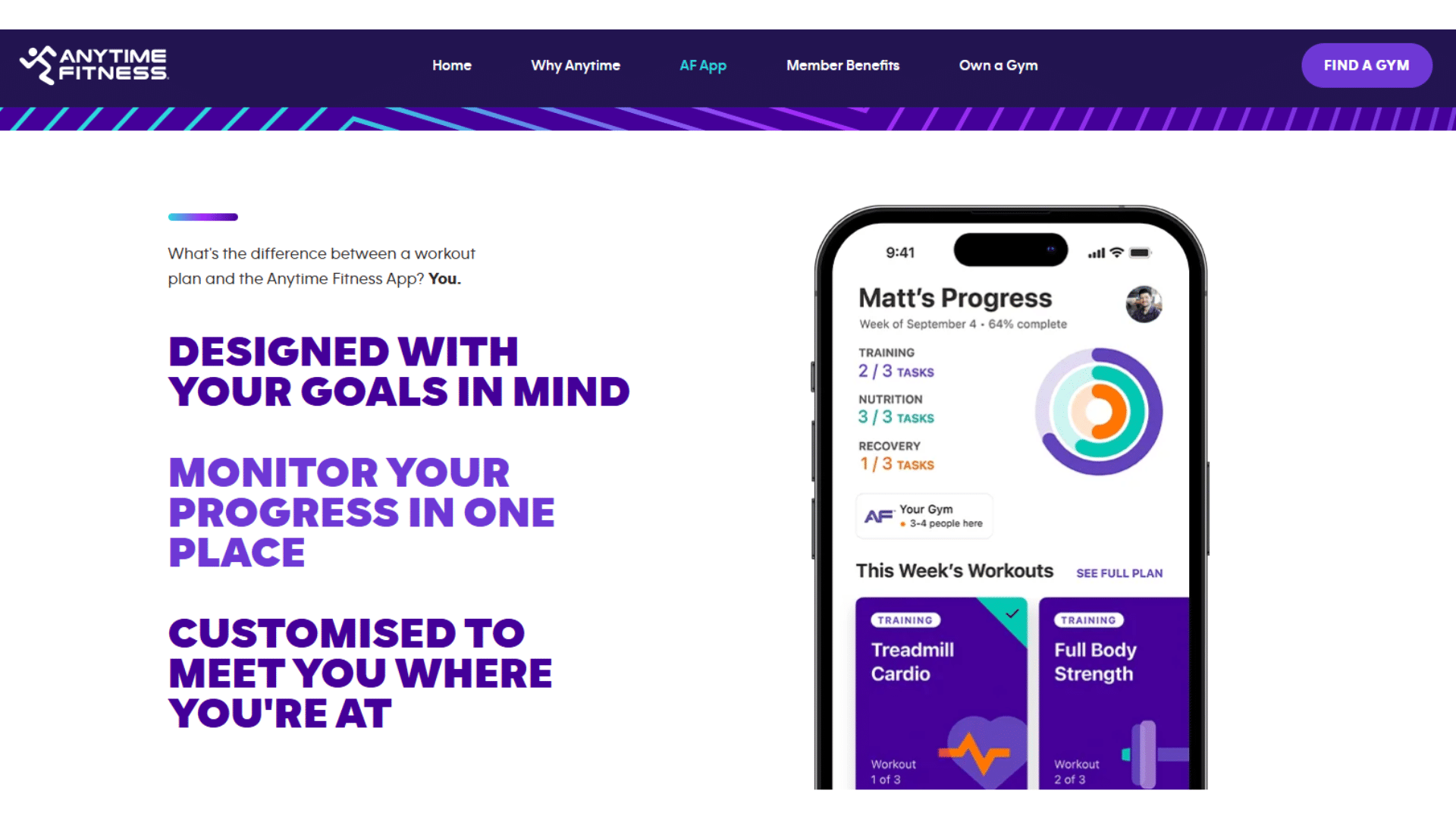
But to a real person scrolling through the site at ten o’clock at night wondering whether they should finally join a gym, none of that means anything.
Gym customers want four things. Lose fat. Build muscle. Look better. Feel confident. That is the entire list. Everything else is a means to one of those ends. Nobody lies awake at night dreaming about progress tracking.
They lie awake thinking about how they want to look at the beach, or how they want to feel walking into a room, or how they want to keep up with their kids without getting puffed.
The copy on the site needs to speak to those desires directly. Instead of saying track your progress, say see exactly how much muscle you are building week by week and adjust your plan to grow faster.
Instead of saying customised to meet you where you are at, say your entire workout plan in your pocket, train anywhere, no gym needed. The difference is subtle in structure but enormous in impact. One version describes a feature. The other paints a picture the reader can feel.
The Emotional Sell Is Missing
There are no pain points being addressed anywhere on the site. No acknowledgement of the frustration someone feels when they have tried and failed before. No recognition of the nervousness a first-time gym goer carries walking through the door. No language that says we understand where you are and we are going to get you where you want to be.
Instead, the messaging reads like vague corporate speak that could be copy-pasted onto any gym website in any country. There is nothing distinctive. Nothing emotionally compelling. Nothing that grabs a visitor by the collar and says this is the place that is going to change things for you.
Emotion sells. Features inform. And you cannot inform someone into a buying decision when they have not been emotionally engaged first.
No Social Proof
This one is hard to believe for a brand of this size, but there is almost no social proof on the website. No testimonials from real members. No before-and-after transformations. No stories of people who joined, stuck with it, and came out the other side looking and feeling completely different.
What they do have is generic stock imagery. Clean, polished photos that look like they were pulled from a template library.

The kind of images anyone could use. There is nothing authentic about them. Nothing that makes a visitor believe this particular gym actually transforms real people.
Social proof is one of the most powerful conversion tools that exists. When someone sees a real person who looks like them, started where they are starting, and achieved the results they want, the mental gap between thinking about joining and actually signing up shrinks dramatically.
It goes from I wonder if this would work for me to it worked for them, so it could work for me.
Anytime Fitness has thousands of locations and presumably hundreds of thousands of members who have had genuine results. The fact that none of those stories are front and centre on the website is a massive missed opportunity.
Show me someone who joined six months ago and lost twenty kilos. Show me someone who could not do a single push-up and is now deadlifting twice their body weight. Give me proof that this works. Because right now there is nothing.
The Real Issue Is Member Churn
Everything above matters because it feeds into the biggest problem in the entire gym industry. Member churn.
The pattern is the same everywhere. People sign up in January full of motivation and good intentions. By March they have stopped showing up consistently. By June they have cancelled or let the membership lapse. Gyms live and die by retention, and the cost of replacing a lost member is roughly ten times higher than the cost of keeping an existing one engaged.
Anytime Fitness is doing very little with their digital presence to solve this. Once someone signs up, the digital relationship largely stops. There is no structured follow-up system keeping members engaged through the app, through email, through SMS, or through any other channel.
What a Retention System Looks Like
A proper retention system treats a membership as the beginning of the relationship, not the end of it. It uses every available channel to stay in touch with the member and give them reasons to keep showing up.
That means sending workout tips tailored to their goals. Celebrating milestones when they hit a new personal best or complete a streak of visits. Running challenges and competitions that create community and accountability. Checking in when attendance drops off instead of waiting for the cancellation request.
The app is already there. It tracks workouts, progress, and activity. All the data needed to trigger personalised engagement already exists inside the system. A member who has not logged a session in two weeks should automatically receive a check-in message.
A member who just hit a new lifting record should get a congratulations notification with a suggestion for the next goal. A member approaching their six-month anniversary should get a celebration and an incentive to stay.
None of this is complicated technology. It is basic automation layered on top of data that Anytime Fitness already collects. The infrastructure exists. The execution does not.
What This Is Really Costing Them
The maths on churn is brutal and it is worth spelling out. Every cancelled membership is not just lost monthly revenue. It is the cost of acquiring a replacement member through advertising, promotions, and sales effort.
It is the compounding lifetime value that walks out the door. And it is the negative word of mouth that happens when someone quits a gym feeling like they wasted their money.
If Anytime Fitness could reduce member churn by just ten percent across their network, the impact would be millions saved in acquisition costs and millions added to the bottom line. Not from new marketing campaigns. Not from new locations. Just from keeping a slightly higher percentage of the people who already made the decision to join.
That is the same principle that applies to every business. Getting new customers is expensive. Keeping existing ones is cheap. But most businesses, including Anytime Fitness, pour the majority of their energy into acquisition and treat retention as an afterthought.
The ones that flip that equation are the ones that build real, compounding, long-term value.
The Opportunity
Anytime Fitness does not have a brand problem. People know the name. They trust the purple logo. They know the twenty-four-hour access model. The awareness is there.
They do not have a product problem either. The gyms are functional. The app has genuine utility. The franchise model gives them scale that most competitors cannot match.
What they have is a systems problem. The website creates friction where there should be flow. The messaging talks about features when it should be talking about feelings. There is no proof on the site that joining actually delivers results.
And once someone becomes a member, there is no digital system keeping them engaged and preventing the slow drift toward cancellation.
Fix the pricing transparency so people can self-qualify without filling out a form. Rewrite the messaging to sell outcomes instead of features. Put real transformations and real testimonials front and centre so visitors can see proof that this gym delivers.
And build a retention system that treats every member like an ongoing relationship, not a completed transaction.
This is not a traffic problem. Anytime Fitness has the traffic, the brand, and the locations. What they do not have is a website and a funnel that converts browsers into members and members into lifers. The money is sitting right there. It just needs the system to pick it up.