

Most business owners treat their website like a set-and-forget brochure. It gets built, it goes live, and then it sits there collecting dust while the world moves on. The problem is that a neglected website is not just a missed opportunity. It is actively costing you money every single day.
The good news is that you do not need a full redesign or a five-figure budget to start getting more out of your site.
There are a handful of changes you can make this week that will have an immediate impact on how your website performs, how visitors experience it, and whether those visitors turn into customers or disappear forever.
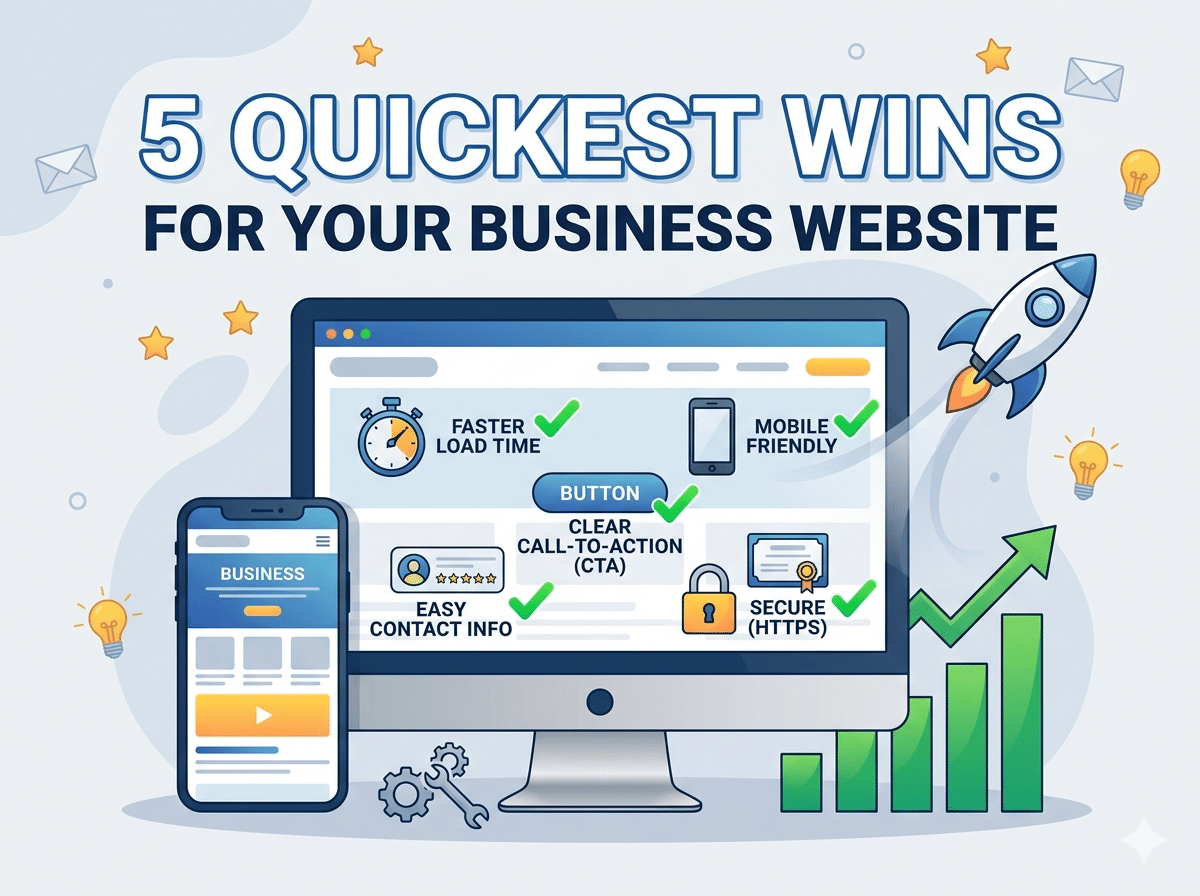
Here are five of the quickest wins you can tackle right now.
#1: Test Your Site Speed and Fix What Is Slowing You Down
If your website takes longer than three seconds to load, you are losing visitors before they even see what you offer.
Research consistently shows that the longer a page takes to load, the higher the percentage of people who simply leave. They do not wait around. They hit the back button and go to a competitor whose site loaded faster.
The first thing you should do is run your website through a free speed test. Google’s own PageSpeed Insights tool is the easiest place to start. Just type in your URL and it will give you a score out of 100 for both mobile and desktop, along with a list of specific issues that are dragging your speed down.
What to Look For
The most common culprits are oversized images, too many plugins or scripts loading on every page, and cheap hosting that cannot handle traffic properly.
Images are almost always the biggest offender. If you are uploading photos straight from your phone or camera without compressing them first, each one could be several megabytes in size. Your entire page should ideally be under two megabytes total.
Compressing your images with a free tool like TinyPNG before uploading them can cut file sizes by 60 to 80 percent without any visible drop in quality. If your site runs on WordPress, installing a caching plugin like WP Super Cache or W3 Total Cache can also make a significant difference by serving pre-built versions of your pages instead of rebuilding them from scratch every time someone visits.
Do not underestimate how much site speed affects everything else. Google uses page speed as a ranking factor, so a slow site hurts your search visibility. It also tanks your conversion rates. Even a one-second delay in load time can reduce conversions by seven percent or more. This is the single easiest diagnostic you can run, and fixing the issues it reveals will pay off across every other metric your site tracks.
#2: Add Email Marketing or Tighten the Funnel You Already Have
If you do not have any form of email capture on your website, you are letting every single visitor walk out the door without a way to follow up.
Think about that for a second. Someone finds your site, has a look around, maybe even likes what they see, but they are not ready to buy right now. Without their email address, that person is gone and you have zero chance of getting them back unless they remember to come back on their own.
At a minimum, you need a simple opt-in form offering something of value in exchange for an email address. That could be a free guide, a checklist, a discount code, or even just a promise of useful tips delivered to their inbox. The key is giving people a reason to hand over their details.
Start for free with Aweber as they have absolutely everything you need.
If You Already Have Email Set Up
If you have already got email capture in place, the next question is what happens after someone signs up. If the answer is nothing, or if they just get added to a list and receive the occasional newsletter whenever you remember to send one, you are leaving a huge amount of value on the table.
The real power of email marketing is in automated sequences that nurtue people into buyers. These are pre-written emails that go out on a schedule after someone opts in.
A good welcome sequence does the heavy lifting for you. It introduces your business, builds trust, delivers value, and nudges people toward a purchase or enquiry, all without you having to lift a finger after the initial setup.
Even a basic three to five email sequence can dramatically increase how many leads convert into paying customers. The first email delivers whatever you promised, the checklist or plan etc.
The second provides genuine value related to their problem. The third shares a story or case study. The fourth and fifth introduce your offer and give them a clear reason to act. This kind of sequence runs around the clock and works on every new subscriber who comes through, whether you signed up ten people this month or ten thousand.
#3: Review Your Home Page and About Page
These two pages carry more weight than most business owners realise. Your home page is almost always the most visited page on your site, and your About page is consistently one of the top three. Yet on most small business websites, both pages are an afterthought.
Your Home Page
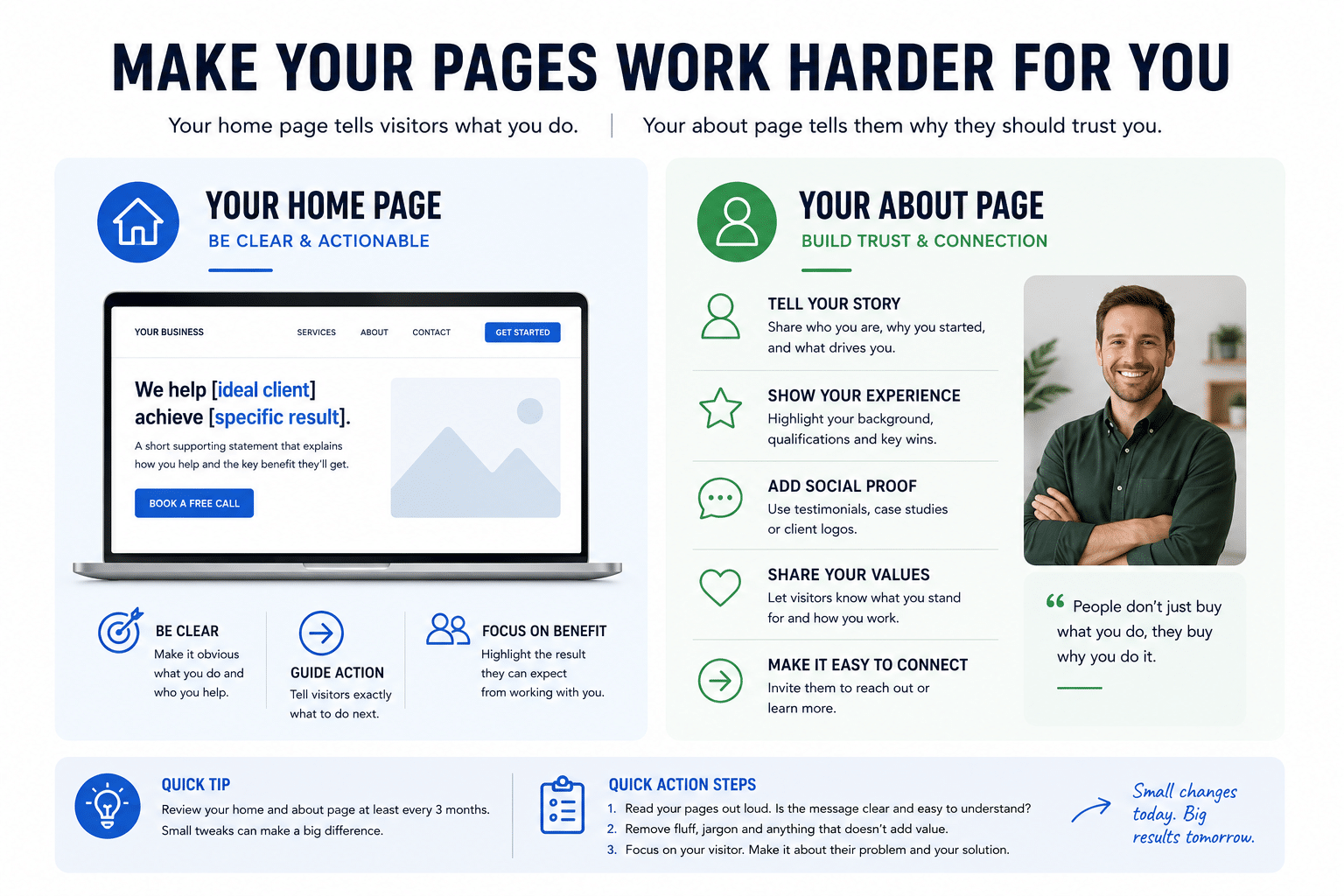
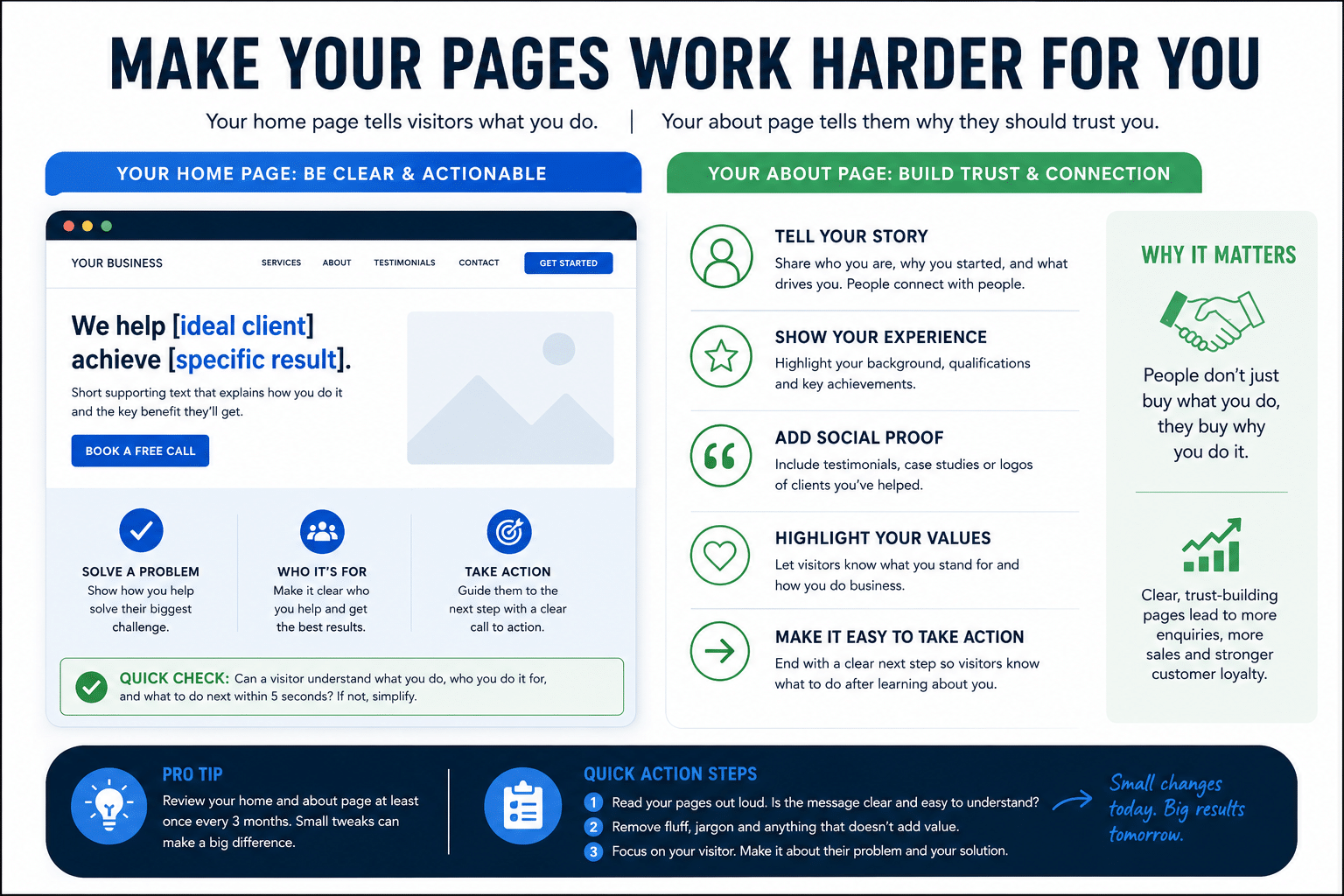
Your home page has one job above all else. Within a few seconds, a visitor needs to understand exactly what you do, who you do it for, and what they should do next. If someone lands on your home page and has to scroll around trying to figure out what your business actually offers, you have a problem.
The headline at the top of your home page should make it immediately obvious what your business does and who it helps. Skip the clever taglines and the vague mission statements. Be direct. Below that, you need a clear call to action. Whether that is booking a call, requesting a quote, or browsing your services, tell people exactly what step to take next and make the button impossible to miss.
Your About Page
Your About page is where people go to decide whether they trust you. It is one of the most underrated pages on any business website. A lot of business owners either leave this page almost empty or fill it with dry corporate language that could belong to any business in any industry.
People want to know who they are dealing with. Share your story. Explain why you started the business, what you believe in, and what makes you different from the dozens of other options they could choose. Use a real photo of yourself or your team. Visitors connect with people, not logos and stock imagery.
A strong About page builds the kind of trust that makes people comfortable enough to pick up the phone or fill out your contact form.
Take ten minutes to look at both of these pages with fresh eyes. Better yet, ask someone who is not familiar with your business to look at your home page and about for five seconds and then tell you what your business does. If they cannot answer clearly, that tells you everything you need to know about what needs to change.
#4: Set Up Google Analytics
If you do not have Google Analytics installed on your website, you are flying completely blind. You have no idea how many people are visiting your site, where they are coming from, which pages they are looking at, how long they are staying, or where they are dropping off. Without that information, every decision you make about your website is a guess.
Google Analytics is free to set up and gives you an extraordinary amount of insight into what is actually happening on your site. The current version is Google Analytics 4, and while the interface takes a little getting used to, the data it provides is invaluable for any business owner who wants to make informed decisions rather than shooting in the dark.
Pro tip: Whilst setting up Google analytics also set up Google search console. This is where you can list your site and sitemap and get in-depth analytics that tells you exactly what you are ranking for in search.
What You Should Be Tracking
Once Google Analytics is installed and collecting data, there are several things you should be paying close attention to.
First, look at your most popular pages. Which pages are getting the most traffic? This tells you what content or services people are most interested in.
If a particular blog post is attracting a lot of visitors, that is a clear signal that the topic resonates with your audience and you should consider creating more content around it.
Second, look at where your visitors are coming from. Are they finding you through Google search? Social media? Direct visits? Referral links from other sites?
Understanding your traffic sources helps you figure out where to focus your marketing efforts. If organic search is driving most of your traffic, investing in more SEO content makes sense. If social media is bringing in visitors, doubling down on what is working there becomes the obvious move.
Third, track how long people are spending on your pages. If visitors are landing on a page and leaving within a few seconds, that page is not delivering what they expected to find. Either the content does not match what brought them there, or the page itself is not engaging enough to hold their attention.
Setting up Google Analytics is a one-time task that takes less than an hour, and from that point forward you have a constant stream of data telling you exactly how your website is performing. There is no reason not to have this in place.
#5: Use Your Data to Make Smarter Decisions
Having Google Analytics installed is only half the equation. The real win comes from actually using the data it gives you to make changes that improve your results.
Most business owners set up analytics, glance at it once or twice, and then never look at it again. That is like buying a set of scales and then never stepping on them.
Dial in and see where most of your customers are coming from and what they are reading the most. On the flip side find the post or pages where people are dropping off and leaving quickly. This is a clear signal to fix or change that content.
Bonus #1: Find Your Best Performing Content
Start by identifying which pages and blog posts are getting the most traction. If you have a blog post that consistently pulls in traffic week after week, that topic is clearly something your audience cares about.
What most people dont do is create more content around that subject. In all businesses, find out what is working and do more of it. It really is as simple as that – keep doing more of what is working!
You can start to make new offers for this content and make even more money.
You should also go into that old content that is doing well and update it to make it longer and link to other great posts on your site. Not only will this tell Google these new links are important, but people will click on them.
The other bonus is Google will now see this older post as updated and not out of date information.
Write follow-up posts, go deeper into specific aspects of it, and link those posts back to the original. You are not guessing at what your audience wants when the data is sitting right there showing you.
The same logic applies to your service pages. If one particular service page gets significantly more traffic than others, consider whether you are giving that service enough prominence on your site.
Maybe it deserves a higher position on your navigation menu. Maybe it should be featured more prominently on your home page. Let the data guide the decisions instead of your assumptions.
Bonus #2: Use That Content to Make More Profits
Using the data from Google analytics you can tell what pages people are using most and where you can create new offers and products.
For example if you own a pet store and a lot of customers are looking at your dog related posts, then start making more content going into more detail and focussing on the main points of everything a dog owner needs to know.
You can then also make and sell ebooks or courses on dogs and related topics or offer a free checklist or guide for dog owners to build your email list.
You can grow your business quickly by doing more of what people are already loving.
Identify Where Visitors Are Dropping Off
One of the most powerful things you can do with your analytics data is identify the pages where visitors are leaving your site. Every website has exit points, but if a disproportionate number of visitors are leaving from a specific page, that page needs your attention.
Ask yourself what might be causing people to leave. Is the page loading slowly? Is the content thin or unhelpful? Is there no clear next step for the visitor to take?
Sometimes a page has a high exit rate simply because there is no call to action pointing visitors to the next logical page.
Adding a simple link or button that guides people deeper into your site can make a measurable difference to how long visitors stick around and how many of them eventually convert.
You should also pay attention to your bounce rate on key landing pages. If people are arriving on a page and leaving without clicking anything else, the page is failing to engage them.
That might be a content problem, a design problem, or a mismatch between what the visitor expected and what the page actually delivers.
Whatever the cause, you will not know about it unless you are regularly reviewing your data.
Make It a Habit
Set a reminder to check your analytics at least once a week. Even a quick ten-minute review can surface insights that lead to meaningful improvements.
Over time, you will develop a much clearer picture of how people interact with your site, what draws them in, and what pushes them away.
That knowledge is worth more than almost any other marketing investment you can make, and it costs you nothing but a small amount of your time.
Start With One and Build From There
You do not need to tackle all five of these in a single afternoon. Pick the one that feels most relevant to where your business is right now and get it done this week.
If you have never checked your site speed, start there. If you have no email capture in place, that should be your priority. If Google Analytics is not installed, that is twenty minutes that will pay dividends for as long as your website exists.
The businesses that grow consistently are not always the ones with the biggest budgets or the flashiest websites. They are the ones that pay attention to the fundamentals, make small improvements regularly, and let the data tell them where to focus next.
These five wins are not complicated and they are not expensive. But they will put you ahead of the majority of businesses that never bother to do any of them.